
“In yet another case before B.C. courts citing the Province’s contentious “Declaration Act”, an ‘Indigenous’ {sic} community is alleging the Crown failed in its constitutional duty to consult and accommodate them when BC Hydro only offered a standard renewal rate for the privately-generated electricity it produces {!}.
“Seeking a judicial review before the B.C. Supreme Court, Lil’wat ‘Nation’ {a ‘nation’ of 2,299 people} is demanding a price equal to brand new energy projects with Aboriginal ownership, a precedent the B.C. government argues would force preferential pricing for ‘Indigenous’ ventures and obligate the Province to shield their investments from market risks.
https://drive.google.com/file/d/1Cc5zkCPhsaz0oOMjWEdpp7iCBLgLpjuq/view “The Lil’wat case is one of an unknown number of cases suing the B.C. government for not complying with its own {irresponsible} 2019 law, the “Declaration on the Rights of ‘Indigenous’ Peoples Act” (DRIPA), legislation intended to channel the principles of the “United Nations Declaration on the Rights of Indigenous Peoples” (UNDRIP) into provincial law.
“Last December, the BC Court of Appeal’s ‘Gitxaala’ decision found that, thanks to DRIPA, UNDRIP is the law in B.C. and sets the “minimum standards” for how provincial laws should be measured. The ruling stated ‘Indigenous’ groups can now use the courts to challenge any provincial legislation they believe is inconsistent with UNDRIP.
https://www.canlii.org/en/bc/bcca/doc/2025/2025bcca430/2025bcca430.html
{NOTE: DNA clearly demonstrates that B.C. Aboriginals are ‘Indigenous’ to Siberia and Mongolia…}
…
“Enter into that fray the Lil’wat case, which invokes DRIPA and could generate yet more volatility onto the British Columbia landscape, this time into electricity costs. As with the previous decisions, the Lil’wat case could have wider ramifications for the whole economy.
“Rockford Energy Corporation is an independent power producer which owns and operates a run-of-river hydroelectric facility on Brandywine Creek near Whistler, B.C. It is one of many companies formed at the turn of the century to sell power to BC Hydro, following government’s call to expand private sector investment in energy.

…
“The Rockford hydroelectric facility sits on land claimed {but unproven!} by Lil’wat and Squamish ‘Nations’ {Squamish ‘First Nation’, a ‘nation’ of 4,764 people}. In 2023, Lil’wat acquired 51% of ‘Eco Flow’, which in turn owns 100% of ‘Rockford’.
“Rockford and Lil’wat refused BC Hydro’s standardized renewal terms, noting that the winning proponents of BC Hydro’s “2024 Call for Power”, which like Rockford have Aboriginal ownership, will receive an average of $86 per MWh.
“To allow negotiations to continue, BC Hydro agreed to enter into a new contract, approved by BCUC, after the original contract expired. However, negotiations appear to have broken down, and on Mar. 10, Lil’wat and Rockford filed a petition in the Supreme Court of BC.
“Lil’wat and Rockford accuse BC Hydro of not consulting Lil’wat about the renewal program and failing to “accommodate their interests” {‘giving them whatever they want’}. Their claim is based on {the racist} ‘Section 35’ of the “Constitution Act”, ‘Section 3’ of DRIPA, and the seminal {segregationist} 2004 ‘Haida’ decision, which found the Crown (which includes BC Hydro) has a duty to consult and accommodate ‘Indigenous’ groups if its conduct “might adversely affect” Aboriginal rights or title {Even when “rights or title” are unproven – which just shows how foolish and irresponsible Canadian courts have become where Aboriginals are concerned}.
https://www.canlii.org/en/ca/scc/doc/2004/2004scc73/2004scc73.html
“The ‘accommodation’ {Race-Based exception} Lil’wat and Rockford are seeking is a higher price for their energy than they would receive under BC Hydro’s standard contract renewals program. They argue that BC Hydro’s “take it or leave it” approach is not appropriate for the Crown when consulting with Aboriginal groups.
{Aboriginal Privilege requires Aboriginal Exceptionalism…}
“Lil’wat claims that without a higher price, it won’t be able to finance its continued ownership in the hydroelectric project, causing it to be unable to support “the social and economic objectives of the Lil’wat Nation from the use of its {claimed but unproven} lands”.

“BC Hydro disagrees.
“They claim they have no duty to consult Lil’wat about the Rockford contract renewal because the hydroelectric facility in question is already operating with Lil’wat’s consent and the community invested in it “well after operations commenced and after the terms of a future [contract renewal] were announced” {!}.
“They also provide evidence of meetings with both Rockford and Lil’wat during the development of the renewal program, and claim the standard renewal price was shared with them prior to Lil’wat’s acquisition of the majority interest in Rockford.
“BC Hydro confirmed that they were not willing to accommodate Lil’wat by paying Rockford more than the standard renewal price. They cite the ‘Rio Tinto’ decision which determined that accommodations do not “extend to adverse impacts on the negotiating position of an Aboriginal group”.
https://www.canlii.org/en/ca/scc/doc/2010/2010scc43/2010scc43.html
“They also point out that Rockford had alternative potential buyers for its energy, including energy marketers or other utilities, such as ‘Fortis’. Or Rockford could export its product directly to the U.S., as two other independent power producers that declined the renewal program have chosen to do.
…
“If BC Hydro paid existing independent power producers more than their best alternative, it would be paying more than it needs to. And, more importantly, so would BC Hydro’s customers.
“Rockford argues that it should receive the higher price that BC Hydro is paying to encourage investors to build new facilities in the province, but this conflates two quite different markets. While the new facilities included in the ‘2024 Call for Power’ must be partially ‘Indigenous’-owned, that’s not why they’re receiving more for their electricity.
“The cost of constructing a new facility versus operating an existing one is considerably different. BC Hydro must offer a sufficiently attractive price for investors to bring their money to the province to build new facilities at today’s costs, which are much higher than they were 20 years ago when Rockford was built. Since BC Hydro does not have the same power over global capital markets as it does over captive suppliers in B.C., it must provide higher incentives for investors to come to B.C.
“For these reasons, the difference between the contract renewal price and the price of energy from new facilities makes economic sense for B.C. and its electricity ratepayers. Rockford’s argument in a letter to BC Hydro that “an electron is an electron” may work in a physics class, but it isn’t a realistic depiction of how electricity markets work in B.C.
“But the petitioners’ argument isn’t based on economics. They want more money simply because Rockford is now part-owned by Lil’wat, an Aboriginal group, and they believe this entitles them to be treated differently from other BC Hydro suppliers.
{Aboriginal Privilege requires Aboriginal Exceptionalism…}
“BC Hydro should have a strong case. The 2004 ‘Haida’ decision requires BC Hydro to consult Lil’wat if it contemplates conduct that may adversely affect its rights or title, but BC Hydro is engaging in no such conduct.
“If BC Hydro had done nothing last October, the original contract would have expired, and Rockford and Lil’wat would have stopped earning revenues. Under that scenario, Lil’wat’s rights would’ve been to earn absolutely nothing from BC Hydro after October. Far from conduct adversely affecting its rights, BC Hydro enabled the community to continue earning uninterrupted revenue when Rockford’s contract expired.
“Instead, Lil’wat wants BC Hydro to improve its economic position by giving Rockford a new contract at a higher price than BC Hydro needs to, or would pay any other supplier in this circumstance. Lil’wat’s desire for more money should not be grounds for consultation, let alone accommodation.
“In the words of the Attorney General, the Supreme Court of Canada’s ‘Rio Tinto’ decision “expressly cautioned against” conflating the principles of consultation and accommodation with commercial negotiations—exactly what Lil’wat and Rockford appear to be attempting to do in this case.
https://www.canlii.org/en/ca/scc/doc/2010/2010scc43/2010scc43.html
“The wild card, however, is DRIPA.
“In last year’s BC Appeal Court ‘Gitxaala’ decision, the B.C. government’s online mineral claims registration system was found to be inconsistent with the “Declaration Act” and UNDRIP. It’s not a big stretch to think that court could now cite DRIPA to find BC Hydro’s renewals program inconsistent with UNDRIP, too.
https://www.canlii.org/en/bc/bcca/doc/2025/2025bcca430/2025bcca430.html
“According to ‘Section 19’ of UNDRIP:
“States shall consult and cooperate in good faith with the indigenous peoples concerned through their own representative institutions in order to obtain their free, prior and informed consent before adopting and implementing legislative or administrative measures that may affect them”. https://laws-lois.justice.gc.ca/eng/acts/u-2.2/FullText.html
“There’s no doubt that the standard BC Hydro renewal price “may affect” Lil’wat, in the sense that it limits how much they might earn from their investment in Rockford. Previously, that might not have been convincing enough to win the case; however, having UNDRIP as the minimum standard may change that.
“BC Hydro’s stance on Rockford’s contract renewal is reasonable. It must have been tempting to just pay more to make the problem go away, with ratepayers unknowingly picking up the tab.
https://justandreasonable.com/bc-hydro-rates-and-more-at-risk-from-new-dripa-related-court-case/
“Instead, the court will have to decide whether Lil’wat’s acquisition of an existing private business with an expiring contract requires BC Hydro to treat that business differently simply because it’s Indigenous-owned.
“If Lil’wat wins this case, it could cause some pretty serious consequences. BC Hydro has contracts with over 100 independent power producers, generating approximately 25% of the utility’s total electricity. If each power producer is acquired by an Aboriginal group and mandated a higher rate of return, it would significantly increase electricity bills in the province.
“But the effects could go far beyond electricity bills, which is no doubt why the B.C. government is supporting BC Hydro in its case. The Attorney General states in its submission that a win for Lil’wat and Rockford would effectively impose
“differential costs on contracts … where Nations have invested in a business venture, and an implicit obligation to insulate their investments in such businesses from market risks”.
https://drive.google.com/file/d/1L_wyS1AvolzHvUp7poUQ5gOMUgGv9I5K/view
“In other words, if BC Hydro loses this case, all B.C. government contracts are at risk of higher costs if the supplier has Aboriginal ownership, fuelling already existing economic uncertainty in the Province.
“And if this happens because of DRIPA, Premier Eby will have only himself to blame.”
–‘Citing DRIPA, Indigenous energy producer sues BC Hydro for higher rates’,
Richard Mason, Northern Beat, May 13, 2026
https://justandreasonable.com/bc-hydro-rates-and-more-at-risk-from-new-dripa-related-court-case/
For more news and analysis from Richard Mason on B.C.’s energy sector:
https://justandreasonable.com/
See also:
 ‘The ‘Indigenization’ of British Columbia Law’ {July 15, 2022}:
Canadian governments are busy establishing a legal framework where Canadian law becomes subservient to the United Nations ‘ Declaration on the Rights of Indigenous Peoples’, regardless of the wishes of the Canadian people. British Columbia – along with the federal government — are foolishly leading the way in this undermining of Canadian democracy:
“A small bill with far-reaching implications. ‘Bill 29’ ran a mere three pages, including cover and explanatory notes. It constituted one of the first substantive moves by the government to amend provincial laws to incorporate the ‘principles’ of the United Nations Declaration on the Rights of Indigenous Peoples. ‘Bill 29’ added a clause that said every
“Act and regulation must be construed as being consistent with the Declaration on the ‘Rights of Indigenous Peoples Act’.
“The latter being the Act whereby two years ago, the legislature unanimously enshrined the 46 articles of the UN Declaration and set in motion an action plan to incorporate them into provincial law.”
 ‘More Tribal Obstruction’ {July 10, 2026}:
“A British Columbia ‘First Nation’ {Indian tribe/Band/extended family} says it has launched a legal challenge against a plan by the Vancouver Fraser Port Authority to dredge Burrard Inlet to make room for oil tankers with larger loads to operate.”
“The Port Authority has previously stated that the dredging project is crucial to increase export capacity to overseas markets while supporting jobs and economic growth, and that federal approvals include extensive conditions intended to protect fish habitat and the environment.”
https://endracebasedlaw.ca/2026/07/10/more-tribal-obstruction/
‘Non-Existent ‘First Nation’ Gets B.C. Court To Stop Mine’ {June 25, 2026}:
“A tiny activist group of about 50 members of Tsetsaut Skii km Lax Ha, just cost BC $30 billion in potential GDP and $7 billion in provincial tax revenue by tying up the KSM mine in court, despite full benefit agreements with the much larger Nisga’a and Tahltan ‘Nations’, who actually support it.”
“Earlier this month, a B.C. court decided to cancel the official go-ahead to construct a gold mine in the north of the province because a few dozen ‘Indigenous’ people weren’t, in its view, adequately consulted.”
https://endracebasedlaw.ca/2026/06/25/non-existent-first-nation-gets-b-c-court-to-stop-mine/
‘Mining Company Screwed by B.C. Government’ (Canadian Gold Ventures Inc./Gitxaala) {June 19, 2026}:
“If this what the government considers ‘Indigenous’ reconciliation, then every investor in B.C. faces grave risk. The Province specifically asked us to step in and rescue this mine – we invested millions, began the necessary work of cleaning up someone else’s environmental mess, and created real economic value for British Columbia. In return, the Province negotiated away our property rights in a backroom deal without involving us or even telling us. That is not how a government should treat investors.”
https://endracebasedlaw.ca/2026/06/19/mining-company-screwed-by-b-c-government/
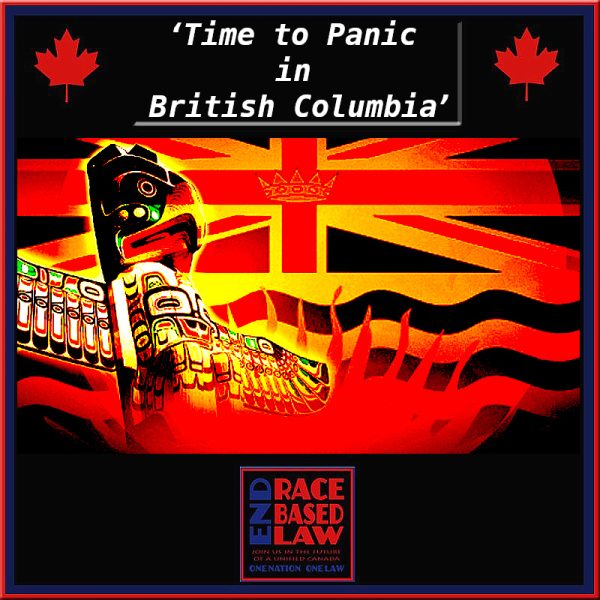 ‘Time to Panic in British Columbia’ {Mar.2, 2026}:
“We, the {1,514} Musqueam people openly and publicly declare and affirm {to the 3 million people of the Vancouver Lower Mainland} that we hold aboriginal title to {your} land and ‘aboriginal rights’ to exercise use of {your} land, the sea and fresh waters, and all their resources within that territory occupied and used by our ancestors…”
—‘Musqueam Declaration’
‘Government of Canada’s landmark agreement recognizes Musqueam ‘First Nation’s Aboriginal title in Metro Vancouver’
“…A February 20 federal news release that received virtually no media coverage.
“The agreement creates a structured framework for gradually implementing Musqueam’s authority in decision-making over much of the Lower Mainland’s lands and waters. Their {claimed but unproven} ‘traditional territory’ includes the region’s mountainous, forested watershed that feed into Metro Vancouver’s drinking water reservoirs, as well as West Vancouver, North Vancouver City, North Vancouver District, Vancouver, the University of British Columbia, the University Endowment Lands, Burnaby, Port Moody, Anmore, Belcarra, New Westminster, Richmond, Vancouver International Airport, the northern areas of Delta and Surrey, and the waterways.”
https://endracebasedlaw.com/2026/03/02/time-to-panic-in-british-columbia/
♠♠♠♠♠♠♠♠♠♠♠♠♠♠♠♠♠♠♠♠♠♠♠♠♠♠♠♠♠♠♠
Websites:
END RACE BASED LAW inc. Canada
https://endracebasedlaw.wordpress.com/
ERBL Canada News Feed
https://endracebasedlawcanadanews.wordpress.com/
♠♠♠♠♠♠♠♠♠♠♠♠♠♠♠♠♠♠♠♠♠♠♠♠♠♠♠♠♠♠♠
Facebook:
ERBL Main Page
https://www.facebook.com/ENDRACEBASEDLAW
ERBL Canada News Feed
https://www.facebook.com/groups/ENDRACEBASEDLAWnewsCanada
♠♠♠♠♠♠♠♠♠♠♠♠♠♠♠♠♠♠♠♠♠♠♠♠♠♠♠♠♠♠♠
TWITTER (X): https://twitter.com/ERBLincCanada
♠♠♠♠♠♠♠♠♠♠♠♠♠♠♠♠♠♠♠♠♠♠♠♠♠♠♠♠♠♠♠
Petition to END RACE BASED LAW
https://endracebasedlaw.wordpress.com/petition-canada/
JOIN US IN THE FUTURE OF A UNIFIED CANADA

