“Two Supreme Court of Canada decisions made it abundantly clear that, while the federal government has a duty to consult, that does not mean that ‘First Nations’ can veto a project.”
“This week {July, 2017}, just days after the new NDP government said it would work to implement a declaration that ostensibly gives ‘First Nations’ {Indian tribes} in B.C. a veto over projects like the Trans Mountain pipeline expansion, the Supreme Court of Canada ruled no such veto exists.
“Overall, the decisions are positive for project development in Canada”,
said Robin Junger, an expert in ‘aboriginal {Race} law’ for ‘McMillan LLP’ and former head of the ‘B.C. Environmental Assessment Office’.
“On one hand, David Eby, the NDP’s new attorney general, confirmed last week what Junger has previously said to be the case – that his government doesn’t have the legal authority to deny permits for the pipeline expansion.
“Those are statutory decisions made by civil servants, not political decisions to be made by cabinet ministers.
“On the other hand, last week Premier John Horgan issued a mandate to Scott Fraser, minister of ‘Indigenous’ {sic} Relations and Reconciliation, to work with’ First Nations’ {Indian tribes}
“to establish a clear, cross-government vision of reconciliation to guide the adoption of the United Nations Declaration on the Rights of Indigenous Peoples (UNDRIP)”.
“That declaration has a clause that states that ‘indigenous’ people have the right to “free prior and informed consent” on development projects within their ‘asserted territory’.
{‘Assertion’ means nothing. Proof is required and the government should be insisting on it instead of virtue-signalling.}
“On the surface, that sounds like the NDP would be handing the Tsleil-Waututh of Burrard Inlet a veto, since they deny the federal government’s and Kinder Morgan Canada’s right to expand the pipeline in their territory – the Burrard Inlet in Burnaby.
“But, as the federal ‘Liberals’ discovered when they, too, promised to implement UNDRIP, actually giving it legal force would require a constitutional amendment, which is why the federal ‘Liberals’ abandoned it.
“Two Supreme Court of Canada decisions this week made it abundantly clear that, while the federal government has a duty to consult, that does not mean that ‘First Nations’ can veto a project.
“In one ruling, the Supreme Court of Canada ruled that regulators like the National Energy Board (NEB) can represent the federal Crown in executing the ‘duty to consult’ ‘First Nations’, but that those consultations must be real, not lip-service.
“In the Clyde River Inuit case, the Supreme Court ruled that the NEB has the authority to represent the Crown in executing its duty to consult, but that, in that particular case, it had failed to do so properly. The court ruled the NEB’s consultation failed to properly address the Clyde River Inuit’s concerns.
https://decisions.scc-csc.ca/scc-csc/scc-csc/en/item/16743/index.do
“The other case, involving the Chippewas of the Thames ‘First Nation’ {a ‘nation’ of 3,128 people} decision, is particularly relevant to the Trans Mountain pipeline expansion. In that case, the court ruled that the consultation with the Chippewas had been adequate.
https://decisions.scc-csc.ca/scc-csc/scc-csc/en/item/16744/index.do
“The Chippewas were objecting to a reversal and expansion of a pipeline owned by Enbridge. The Supreme Court ruled against the Chippewas in that case and in doing so affirmed that, provided consultations are adequate, ‘First Nations’ don’t have the legal authority to stop developments in ‘their’ {former, claimed and often surrendered by Treaty} territory.
“The duty to consult does not provide a ‘veto’ for ‘indigenous’ peoples over Crown decision”,
Blake, Cassels & Graydon LLP explains in a legal brief on the two cases.
“So, what does that mean for the NDP’s promise to implement UNDRIP? Junger said it is clear that it has no legal force.
“This is the law”,
Junger said.
“No elected person can change the law by statements.”
“Courts have interpreted Section 35 of our Constitution as saying there’s no veto. So I don’t think any government would have the power, even by legislation, to make that change. It would have to be a constitutional amendment. You can’t make it law by saying you endorse it.”
–‘First Nations can’t veto energy projects, Supreme Court affirms’,
Nelson Bennett, July 28, 2017
https://biv.com/article/2017/07/supreme-court-decisions-good-development-projects
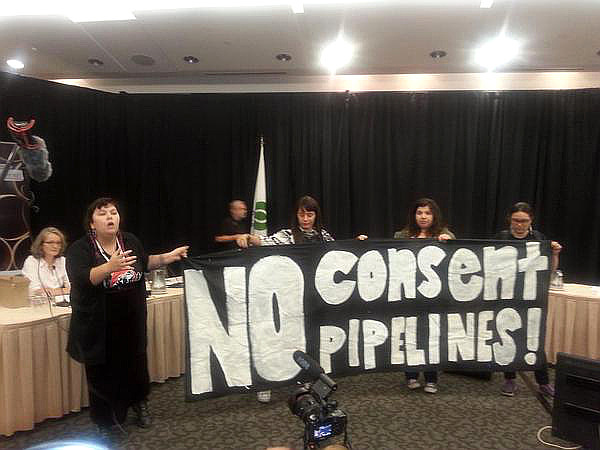
This is the type of claim that the Supreme Court was responding to:
“A ‘First Nations’ Chief is urging the Prime Minister to respect the ‘right’ of aboriginal groups to VETO pipeline and liquefied natural gas projects in the country…“ {!?!}
“The report by a {federal} ‘special envoy’ {Aboriginal advocate} on West Coast energy issues made a plethora of recommendations on working with Aboriginal groups on all new projects, but ‘First Nations’ are concerned it glosses over their ‘right to say no’.
“‘Union of BC Indian Chiefs’ Vice President Bob Chamberlin is calling on all levels of government to listen to concerns of ‘First Nations’ over fracking, oil spill safety or land rights…
“If provincial and federal governments don’t listen, Chamberlin warns
“[Government] is going to find there’s going to be resistance on the ground. I’ve talked to many ‘First Nations’ people that are just waiting for the wrong answer from the government to take to the streets and do the protests that are necessary”.
–‘First Nations’ say veto of energy projects must be respected’,
Sara Norman, News1130, December 8, 2013
http://www.news1130.com/2013/12/08/first-nations-say-veto-of-energy-projects-must-be-respected/
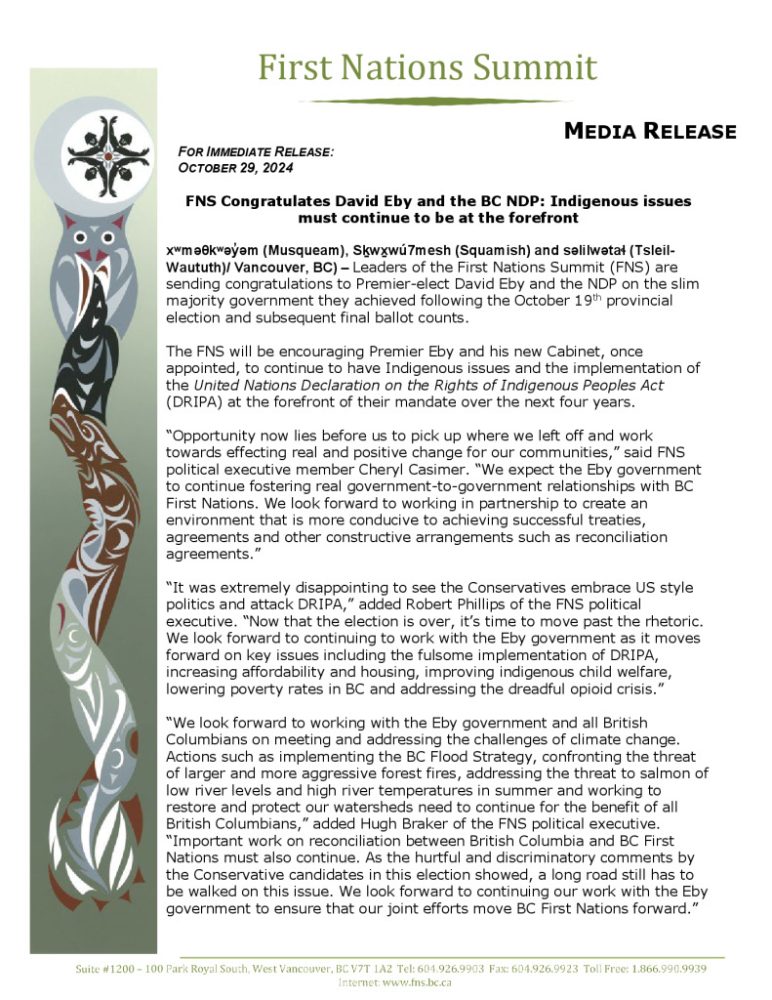
“We live in strange times. A new generation of political leaders seems determined to cripple their own societies. Prime Minister Justin Trudeau, of course, comes to mind. But in Canada, he is not alone. In British Columbia, NDP Premier David Eby is preparing to bring his province to its knees.
“The B.C. government plans to share management of ‘Crown’ land with ‘First Nations’ {Aboriginal Tribes/communities}. The scheme will apply not to limited sections of public land here and there, but across the province. The government quietly opened public consultations on the proposal last week. According to the scant materials, the government will amend the ‘B.C. Land Act’ to incorporate agreements with ‘Indigenous’ {sic} governing bodies.
“These agreements will empower B.C.’s hundreds of ‘First Nations’ to make joint decisions with the minister responsible for the ‘Land Act’, the main law under which the provincial government grants leases, licences, permits and rights-of-way over ‘Crown’ land. That means that ‘First Nations’ will have a veto over how most of B.C. is used. Joint management can be expected to apply to mining, hydro projects, farming, forestry, docks and communication towers, just to start. Activities at the heart of B.C.’s economy will be at risk.
“In 2007, the United Nations General Assembly adopted the ‘Declaration on the Rights of Indigenous Peoples’ (UNDRIP). UNDRIP {foolishly} states, among other things, that ‘Indigenous’ people own the land and resources of the countries in which they live. They have
“the right to the lands, territories and resources which they have traditionally owned, occupied or otherwise used or acquired… to own, use, develop and control”.
“At the time, Canada sensibly voted “No”, along with the United States, Australia and New Zealand. Eleven countries abstained. In 2016, Trudeau’s government reversed Canada’s objection.
“As a General Assembly declaration, UNDRIP is not binding in international law nor enforceable in domestic courts. But in 2019, under the leadership of Eby’s predecessor John Horgan, the B.C. legislature passed ‘Bill 41’, the ‘Declaration on the Rights of Indigenous Peoples Act’. The act requires the government of B.C. to “take all measures necessary to ensure the laws of British Columbia are consistent with the Declaration”. Eby’s joint management plan is the next step in this project.
{‘The ‘Indigenization’ of British Columbia Law’ {July 15, 2022}:
“Canadian governments are busy establishing a legal framework where Canadian law becomes subservient to the United Nations ‘ Declaration on the Rights of Indigenous Peoples’, regardless of the wishes of the Canadian people. British Columbia – along with the federal government — are foolishly leading the way in this undermining of Canadian democracy:
“A small bill with far-reaching implications. ‘Bill 29’ ran a mere three pages, including cover and explanatory notes. It constituted one of the first substantive moves by the government to amend provincial laws to incorporate the ‘principles’ of the United Nations Declaration on the Rights of Indigenous Peoples. ‘Bill 29’ added a clause that said every
“Act and regulation must be construed as being consistent with the Declaration on the ‘Rights of Indigenous Peoples Act’.”
“The latter being the Act whereby two years ago, the legislature unanimously enshrined the 46 articles of the UN Declaration and set in motion an action plan to incorporate them into provincial law.”
“Long before UNDRIP, the Supreme Court of Canada created a constitutional “duty to consult” with Aboriginal peoples. The court said that the “honour of the Crown” governs the relationship between the government and Aboriginal people. The ‘Crown’s fiduciary duties include a duty to consult whenever proposed action may adversely affect established or asserted Aboriginal rights under ‘Section 35’ of the Constitution. This duty is notoriously uncertain, onerous and time-consuming. It has become an albatross around the neck of the Canadian resource industry. The courts seem unable to specify what the duty to consult requires, except after the fact.
“Now, the B.C. government aims to make things even more unpredictable. Whatever the contours of the right to be consulted, the Supreme Court at least has been clear that it does not constitute a veto.
“Eby will create one. Shortly before the B.C. legislature passed ‘Bill 41’ in November 2019, the ‘Continuing Legal Education Society of British Columbia’ sponsored an ‘Aboriginal Law Conference’ featuring several ‘Indigenous’ proponents of the Bill. They promised that the new law would render the province unrecognizable.
“It will “set up a whole new norm“, “give teeth to (UNDRIP)”, and move the province away, if “not fully”, from the Westminster model of governance. The veto to be conferred on ‘Indigenous’ interest groups, they said, will mean that
“consent will not be given very often, if at all”.
“We’re not talking small changes; we’re talking big changes”,
one speaker suggested, adding that money provided by the government so far hasn’t been enough.
“Compensation for sacred sites, for lands taken, for relocation… it’s going to be an overwhelming number of compensation claims… and so I’m hoping that the province is ready for that… Life (in B.C.) can and will change.”
“For many, it is likely to change for the worse. B.C. could become an untenable host for land-based, resource-related enterprise. Impenetrable layers of red tape would entangle applications for leases and licenses. The price for ‘First Nations’ approvals could be an increasing share of royalties and kickbacks, without which consent will be refused {Legal extortion}. Both governments and ‘First Nations’ will siphon an ever-larger piece of a shrinking pie.
“The government’s timeline is short. Written submissions will be accepted until the end of March, and anyone giving feedback will be limited by how little information the B.C. government has offered in the consultation. Bureaucrats will begin drafting amendments to the ‘Land Act’ in early February, and the government plans to introduce a bill in April or May.
“If you are feeling grateful not to live in B.C., don’t count your chickens. In 2021, Parliament passed its own version of B.C.’s ‘Bill 41’, the federal ‘United Nations Declaration on the Rights of Indigenous Peoples Act’. It requires the federal government to “take all measures necessary to ensure that the laws of Canada are consistent with the Declaration”. An action plan, outlining more than 100 specific measures, was released in 2023.
“In a speech to the ‘B.C. Business Council’ in 2016, I argued that our leaders could not do a better job of preventing Canadian business from succeeding in the global economy. I underestimated them. Their determination and ingenuity know no bounds.”
–‘B.C. plans to ‘reconcile’ by giving First Nations veto on land use’,
Bruce Pardy, Fraser Institute (National Post), February 01, 2024

“Although the ‘UN Declaration on the Rights of Indigenous Peoples’ (UNDRIP) is not a binding legal instrument and has never been ratified as a treaty would be, the federal government did issue a statement “endorsing” it 2010 {Even though Canadian Aboriginals are ‘Indigenous’ to Mongolia and Siberia}.
“The Supreme Court of Canada has been clear – both before and after the UNDRIP was endorsed – that our constitutional framework does not give Aboriginal groups a veto right in respect of asserted rights and title … The leading case is ‘Haida Nation v. British Columbia (Minister of Forests) 2004 SCC 73’ where the Supreme Court of Canada made clear that aboriginal groups with asserted rights and title do not have a veto…”
https://decisions.scc-csc.ca/scc-csc/scc-csc/en/item/2189/index.do
–‘THE LAW OF CANADA IN RELATION TO UNDRIP’,
Canadian Environmental Assessment Agency (CEAA)
https://ceaa-acee.gc.ca/050/documents/p63928/92200e.pdf
^^^^^^^^^^^^^^^^^^^^^^^^
“There has been a great deal of media attention to the federal government’s recent passage of ‘Bill C-5’ – the ‘Building Canada Act’ – intended to expedite projects designated as in the “national interest”. B.C. and Ontario have also passed similar legislation. Many ‘Indigenous’ leaders’ responses have been swift and strong, stating unequivocally that such projects cannot proceed without their consent. This raises the thorny-but-important question of whether these projects will in fact require ‘Indigenous’ consent to proceed.
“On June 3, 2025, federal Minister of Justice and Attorney General Sean Fraser appeared to answer that question, stating ‘Indigenous’ groups do not possess a blanket veto. But he immediately backtracked and while noting his “innocent intentions”, he apologized the next day for “caus[ing] hurt and potentially erod[ing] a very precarious trust”.
“What then does this mean for companies looking to advance “nation building” projects in Canada? Did the Justice Minister misspeak the law?
“The short answer is no. Under Canada’s constitutional framework for protecting ‘Indigenous’ rights, governments are required to consult ‘Indigenous’ groups with a view to accommodating their interests and reasonably balancing them with larger societal needs. But the Supreme Court of Canada has repeatedly held that this does not amount to giving ‘Indigenous’ ‘rights’ holders a veto.
…”
–‘Do ‘Nation Building Projects’ Depend on Indigenous Consent?’,
Robin M. Junger, Joan M. Young and Radha Curpen, ‘Indigenous’ Law Bulletin, McMillan LLP, July 29, 2025
https://mcmillan.ca/insights/do-nation-building-projects-depend-on-indigenous-consent/
^^^^^^^^^^^^^^^^^^^^^^^^
From the ‘Ktunaxa’ Supreme Court ruling:
“The duty to consult and, if appropriate, accommodate Aboriginal interests may require the alteration of a proposed development. However, it does not give Aboriginal groups a veto over developments pending proof of their claims.”
–‘Supreme Court: Charter does not protect Ktunaxa sacred site’,
Senwung Luk and Krista Nerland, OKT LLP
https://www.oktlaw.com/supreme-court-charter-not-protect-ktunaxa-sacred-site/
^^^^^^^^^^^^^^^^^^^^^^^^
“While courts have reaffirmed that ‘Indigenous’ {sic} groups do not have a veto over project development as part of the duty to consult and accommodate, governments continue to grapple with the concept of “Free, Prior and Informed Consent (FPIC)”, and whether it ought to be a requirement for project development..”
–‘Indigenous law update’,
Norton, Rose, Fulbright LLP, July 2020
BACKGROUND:
 ‘Balkanizing British Columbia’ {Jan.16, 2020}:
“British Columbia politicians are thoughtlessly embedding Race law, two-tiered ‘rights’, and United Nations influence in all aspects of B.C. legislation:
“Horgan told the chiefs his government has a lot of work ahead {!}, to adapt provincial legislation {to segregate British Columbia} to the dozens of articles of the UN declaration {Some of which are CONTRARY to the Canadian Constitution}…”
https://canadiansforlegalequalityblog.wordpress.com/2020/01/16/balkanizing-british-columbia/
‘B.C. Gov’t Betrays the Interests of Most Residents’ April 7, 2019}:
“As throne speech commitments go, not many over the years have been more fraught with consequences for B.C. than the one proclaimed by the John Horgan N‘D’P government. B.C. will be the first province in Canada to introduce legislation to implement the United Nations Declaration on the ‘Rights’ of ‘Indigenous’ People”, it read in part:
“The goal is
“mandating government to bring provincial laws and policies into harmony with the declaration.”
https://endracebasedlaw.ca/2019/04/07/b-c-govt-betrays-the-interests-of-most-residents/
 ‘UNDR‘I’P Unworkable’ {May 15, 2017}:
“Even for a government with a disproportionate aboriginal influence, implementing the foolish ‘United Nations Declaration on the Rights of {so-called} ‘Indigenous’ Peoples’ {UNDR‘I’P} is proving to be a political and economic impossibility.”
https://saynotosegregationblog.wordpress.com/2017/05/15/undrip-unworkable/
‘UN ‘indigenous rights’ declaration is ‘unworkable’ as law’ {July 15, 2016}:
“Jody Wilson-Raybould, the justice minister, spoke at the A‘FN’s general assembly in Niagara Falls where she dropped the bombshell that adopting the ‘United Nations Declaration on the Rights of Indigenous Peoples’ as Canadian law is “unworkable”…”
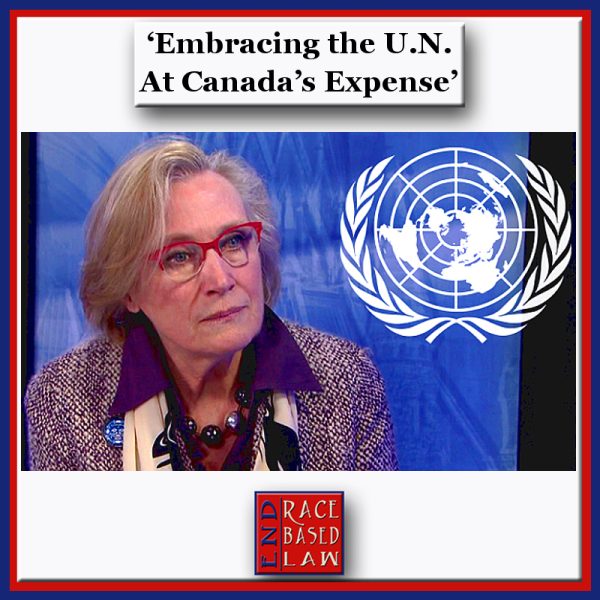 ‘Embracing the U.N. at Canada’s Expense’ {June 4, 2016}:
“‘Indigenous’ Affairs Minister Carolyn Bennett said…Canada would fully embrace the UN ‘Declaration on the Rights of ‘Indigenous’ Peoples’ (UNDR‘I’P) and remove its “permanent objector status” to the document.”
https://endracebasedlaw.wordpress.com/2016/06/04/embracing-the-u-n-at-canadas-expense/
 ‘Carving Up Canada’, (U.S. Foundations) {Oct. 6, 2020}:
“The so called Wet’suwet’en blockade of the Coastal Gas-link pipeline has brought to the surface a very small part of massive funding of Astro-Sage “Indigenous” organizations. This phenomenon is being used by massive private foundations to disrupt Canada, economically and socially…”
https://canadiansforlegalequality.wordpress.com/2020/10/06/carving-up-canada/
♠♠♠♠♠♠♠♠♠♠♠♠♠♠♠♠♠♠♠♠♠♠♠♠♠♠♠♠♠
Websites:
END RACE BASED LAW inc. Canada
https://endracebasedlaw.wordpress.com/
ERBL Canada News Feed
https://endracebasedlawcanadanews.wordpress.com/
♠♠♠♠♠♠♠♠♠♠♠♠♠♠♠♠♠♠♠♠♠♠♠♠♠♠♠♠♠♠♠
Facebook:
ERBL Main Page
https://www.facebook.com/ENDRACEBASEDLAW
ERBL Canada News Feed
https://www.facebook.com/groups/ENDRACEBASEDLAWnewsCanada
♠♠♠♠♠♠♠♠♠♠♠♠♠♠♠♠♠♠♠♠♠♠♠♠♠♠♠♠♠♠♠
TWITTER (X): https://twitter.com/ERBLincCanada
♠♠♠♠♠♠♠♠♠♠♠♠♠♠♠♠♠♠♠♠♠♠♠♠♠♠♠♠♠♠♠
Petition to END RACE BASED LAW
https://endracebasedlaw.wordpress.com/petition-canada/
JOIN US IN THE FUTURE OF A UNIFIED CANADA
 END RACE BASED LAW Daily News Canada